
All posts by admin

Rita Gangwani is a leading personality transformation mentor, executive coach, corporate trainer, pageant coach, author and motivational speaker, dedicated to helping people become confident, polished, powerful and purpose-driven versions of themselves. Her work begins with personality transformation. She helps individuals refine their confidence, communication, body language, etiquette, grooming, public speaking, leadership presence and self-image. Whether working with professionals, students, leaders, pageant aspirants or individuals seeking personal growth, Rita’s approach focuses on building both inner strength and outer impact. As an executive coach and corporate trainer, Rita has trained professionals and students at some of the top management institutes in the country, helping them develop executive presence, professional grooming, confident communication, leadership skills and the ability to create a lasting impression in personal and professional spaces. She is also the founder of RIGAHAUS and one of India’s most respected names in pageantry and grooming. Rita Gangwani is the only pageant coach to have been honoured by the World Book of Records for coaching diverse beauty pageant aspirants across categories including Miss, Mrs, Mr, Teens, Pre Teens, Empress, Classics, Petite, Transgender, Plus Size, Deaf, Blind, Wheelchair, Cancer Survivors, Kids, Toddlers and many more. Her contribution has been recognised through several prestigious national and international awards. Rita is also the only Indian pageant coach to have authored a bestselling pageant book, Beauty Pageants Greenroom, with a foreword by former Miss Universe Sushmita Sen. The book has become a powerful guide for aspirants who wish to understand the world of pageantry with clarity, confidence and preparation. A former officer from the Indian Armed Forces, Rita brings discipline, dignity, grace and leadership into her mentoring. She is also a State and National pageant winner, having won Himachal Queen 1982 and Mrs. Supreme Universe 2019. Her journey reflects her own powerful belief: “Be a stiletto in a room full of flats.” Known lovingly by her students as “GURUCOOL”, Rita is admired not only for her expertise, but also for her kindness, generosity and deep commitment to empowering others. During the lockdown, she digitally helped hundreds of personality development and pageant enthusiasts learn essential skills free of cost under Vidya Daan. She continues to support workshops for the underprivileged, carrying forward her mission of making confidence, grooming and transformation accessible to all. Through RIGAHAUS, Rita Gangwani continues to inspire individuals, professionals, students, leaders and pageant dreamers to rise with confidence, grace and purpose. Her mission is simple yet powerful: to help every person transform their personality, discover their highest potential and walk into the world with presence, polish and self-belief.

Rules Of A Good Hand Shake

Shaking hands is the most common greeting and gesture of good will. It is an art because it takes two people, in unison and agreement, to complete the act.It’s pointless extending your hand for a proper greeting when the other party is distracted or rushing off. Engagement is crucial so ensure the timing is right before making the gesture.

In business settings, whoever is hierarchically senior should initiate the handshake, e.g. during a job interview, the recruiting manager should offer a handshake to the candidate. In social interactions, allow older people and women to take the initiative.

Learning the art of the handshake is so easy. The aim is to be experienced as assertive, rather than passive or aggressive.

Three Steps to follow for an Effective Handshake

The Reach 

Keep between three to four feet (or 1 to 1.25 meters) between you and the person you will be shaking hands with. Don’t get too close and invade the other person’s personal space. Stand with proper posture.If seated, etiquette requires you stand up to shake hands.

Before extending your hand, introduce yourself. Extending your hand should be part of a business inroduction, not a replacement for using your voice.As u approach, extend your right hand in a vertical position with your thumb raised.Always offer your right hand for a handshake, unless there is an obvious reason why you should use your left, e.g. if either party’s right hand is injured. Ideally, as you reach toward each other’s hands, the first touch occurs when the web junctures between thumbs and index fingers meet. You’ll hardly notice it happening, but the “web-touch” is where the true handshake begins! If the web-touch doesn’t occur, a great handshake is very unlikely!

Ladies, Forget “Lady Fingers”. Offering only your fingers to shake may be appropriate in some social settings, but in business settings,you are an equal, not a “lady.” Extend your entire hand, and be sure to grasp using your entire hand as well.

The Clasp

Next, you will find yourself naturally entering into the clasp the moment that the “web-touch” has occurred. As the palms meet, clasp your fingers around your partner’s hand. The eyes meet! The clasp is the heart of the handshake. a gentle squeeze conveys warmth, but not so strongly that you feel the person’s pulse.In a business or political context, this entire ritual takes on a symbolic meaning so, unless you want to appear as overpowering or intimidating, do not use your left hand to “cup” the handshake or pat the person’s shoulder.

The Shake

With hands connected, , enter the shake.Shake From Your Elbow.If you shake from the shoulder, using your upper arm instead of just your forearm, you risk jolting your handshake partner. The idea is to connect, not be overbearing. Move your hands up and down a couple of times (no more than three), then release withing 7 seconds.Eyes connect until the handshake ends. Keep a smile on your face.

To avoid creating an awkward moment, your shake should end before the verbal exchange does. Without conversation taking place during the entire handshake, it becomes too intimate and can feel more like hand-holding.

Handshakes rituals differ from culture to culture, eg:, In Japan people may bow rather than shake hands and in the Arab world you should only initiate handshakes with people of your own gender…and so forth. Its always safe to read about International Business etiquette before u travel to a certain country and make an effort to respect the social norms.
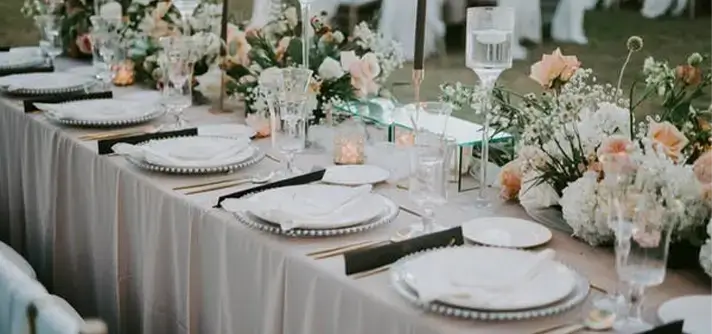

Navigate Through Fine Dining Placement

We live in a world where people are compared and judged all the time, and we are always looking to create the right impression. Business dinner or formal gathering, is an opportunity to network, exchange knowledge and you want to focus on that. But if you are sitting there and going, ‘oh!which fork do I use now?’ or ‘Am I going for the right glass?’ You become so conscious that you are unable to focus on the important things.

As for the place setting, remember the luxury car “BMW” .When we go out dining, we have lots of plates, the silverware, glasses, which can be confusing. The important thing to remember is bread is always on the left (B), your meal is in the centre(M) and your water is on your right(M)- BMW. If you remember this you know which bread plate and glass of water is yours.

The following guide provides tips on perfect table setting for informal dining, formal dining.

General Rules

  • Utensils are placed in the order of use from farthest from the dinner plate, to closest to the dinner plate. This means that utensils that will be used first are closest to the plate and utensils being used last are farthest, in an “outside-in” order.
  • Another rule is that forks go to the left of the plate while knives and spoons go to the right.

Informal Place Setting

  1. The dinner plate is the first thing to be set on the table, with a napkin placed on top of the plate.
  2. The dinner Fork  is usually placed to the left of the plate. Since it is used for the main course; it will be usually be used last.
  3.  The  Salad Fork, which is the smaller fork, is placed to the left of dinner fork and is used to eat salad or appetizers.
  4.  The napkin is folded or put in a napkin ring and can be placed to the left of the forks or on the center of the dinner plate.
  5.  The dinner knife is set to the right of the dinner plate, with the cutting blade placed facing inward. If the main course is meat, a steak knife may replace the dinner knife.
  6. The spoons are placed to the right of the knife. When soup is served first, the soup spoon will be placed to the far right of the dinner knife. The teaspoon or dessert spoon, (which will be used last) goes to the left of the soup spoon, next to the dinner knife.
  7.  Any type of  drinking glass is placed at the top right of the dinner plate, above the knives and spoons.
  8.  If using a salad plate, it is placed to the left of the forks. A salad plate may be omitted if the salad is to be eaten with the meal, and it can be served directly on the dinner plate. However it is more acceptable to serve the salad on a separate plate to keep things neater.
  9.  The bread plate goes above the forks, with the butter knife placed diagonally across the edge of the plate, with the handle on the right side and the blade facing down.
  10. If using a dessert spoon and fork, then these utensils can be placed either horizontally above the dinner plate, with the spoon on top and its handle facing right and the fork below with its handle facing left; or beside the plate. If placed beside the plate, the fork goes on the left side, closest to the plate (because it will be the last fork used) and the spoon goes on the right side of the plate, to the right of the dinner knife and to the left of the soup spoon for the same reason.
  11. When a  Coffee cup and saucer are used, then the coffee cup and saucer are placed above and to the right of the knife and spoons.

Formal Place Setting

  1. The placement of utensils is guided by the menu, so the utensils are placed in the order of how the meal will be served, with the utensil to be used by the first menu item being placed on the outside, and so on as the menu dictates in an “outside-in” order.
  2. The  Charger Plate is the largest plate on your table setting. It is known by a few different names such as buffet plate, cover plate and service plate. This plate serves as a base on which to lay the plate for the appetizer course or soup course and is cleared from the table after the first or second course is finished.
  3. When the first course is cleared, the charger plate remains on the table until the plate holding the entree is served, at which point the two plates are exchanged. The charger plate can also serve as the base for several courses served after the entree.
  4.  The butter plate is a small plate that is placed above the forks, above and to the left of the charger plate.
  5. The dinner fork is largest of the forks and used for the main course so it is placed to the left of the dinner plate.
  6.  The position of the salad fork varies according to when the salad is being served. If the salad is served after the entree, then the salad fork is placed to the right of the dinner fork, next to the plate. If the salad is to be served first and the fish second, then the salad fork would be first, then the fish fork, and finally the dinner fork, closest to the dinner plate.
  7.  When fish is served as a first course, the small fish fork is placed farthest to the left of the dinner fork as it will be used first. If shellfish are to be served, the Oyster fork goes to the right of the spoons. It is the only fork that will be placed on the right of the plate.
  8.  The Large dinner knife is placed to the right of the dinner plate.
  9.  The fish knife is placed to the right of the dinner knife.
  10.  If soup or fruit is served as a first course, then the appropriate spoon is placed to the right of the knives.
  11. The butter knife or butter spreader is placed diagonally on top of the butter plate, with the handle on the right and the blade facing down.
  12. The dessert spoon, dessert fork and dessert knife, depending on what is being served, is placed horizontally above the charger plate as shown above.
  13.  There can be up to five glasses on a formal dining setting and they are placed so that the smaller ones are up front. The water goblet is placed directly above the knives. Just to the right goes a champagne flute; in front of these are a red or white wine glass and a sherry glass.
  14. The napkin is usually placed on top of the charger plate, or instead of one in a formal dining setting.
  15. The cup and saucer are placed to the far right of the soup spoon.

Dining skills say a lot about a person and not knowing it can be more damaging than you would think, especially for people in high positions.

Mood Lifter!!

Most of us absolutely love music. We are compelled by it. We are provoked by it. We are moved by it. We are inspired by it. We feel connected to it. It reflects something profound about who we are and our experience of the world.Because sometimes life is really hard. Really really hard. Whether it be conflict with someone, ending a relationship, or experiencing trauma, we all have moments in which we are brought to our knees with pain, sadness, and confusion.

For people like me, music is an outlet. Just like reading and writing, I find myself getting caught up in the words, analyzing different meanings behind the verses, and trying to understand how something so beautiful could relate to me. No matter what mood you are in, there’s always a song that perfectly understands your situation and how you’re feeling. Personally, I listen to music every day and I can’t imagine what life would be like without it. There is no better feeling than hearing the right song at the right time. It doesn’t matter what the setting is, hearing the right song in that moment is one of those simple pleasures in life that instantly lifts your spirits. You could be driving home from work, hanging out with friends, or jogging.

When the right song for that moment rattles your ear drums the entire meaning of life momentarily makes complete sense.Music is a moral law. It gives soul to the universe, wings to the mind, flight to the imagination, and charm and gaiety to life and to everything.In these tough life moments, music can be a constructive way to express who you are and what you are feeling. If you are feeling particularly sad about a reality in your life, listen to a song that connects you to that emotion. If you are anxious, turn up the volume in your living room and dance around. If you are angry, grab a pillow and hit is as hard as you can while listening to your favorite lyrics.

I am not suggesting that you use music to wallow in pain or negativity; that would not be positive for your mental health or for those around you. What I am suggesting is that when we are emotionally struggling, the intellectual, verbal expression of feelings doesn’t do justice to our experience of the emotion. But it can surely help u cope in that moment. Think about it!!